
Mobile Homes, Container Living and Rustic Land on the Costa del Sol, The Big idea Investment Trend… or a Disaster Waiting to Happen?
- Eva Brown
- Jun 15
- 5 min read

I’ve had a strong urge lately to write something about this topic, mainly because of the increasing number of enquiries I’m getting and, honestly, because of the amount of confusion and misinformation I keep seeing around it.
More and more people are asking me about buying rustic land to place a mobile home, modular home or my "personal favourite" a shipping container converted into a house.
And I do completely understand why.
Property prices on the Costa del Sol have gone crazy.
Urban plots are expensive.
Construction costs are expensive.
Rent is expensive.
Life is… well, expensive.
So when someone sees a YouTube video saying:
“Buy cheap land in Spain.”“Live off-grid.”“Become self-sustainable.”“No mortgage.”“No stress.”“Your own paradise for €50,000.”
…of course it sounds tempting.
Especially for foreigners who are tired of the rat race, want a simpler life, maybe grow their own vegetables, run on solar power and finally escape the system.
Honestly? I get the appeal.
The dream itself isn’t the problem.
The problem is when the dream gets sold as if there are no legal, financial or practical consequences.
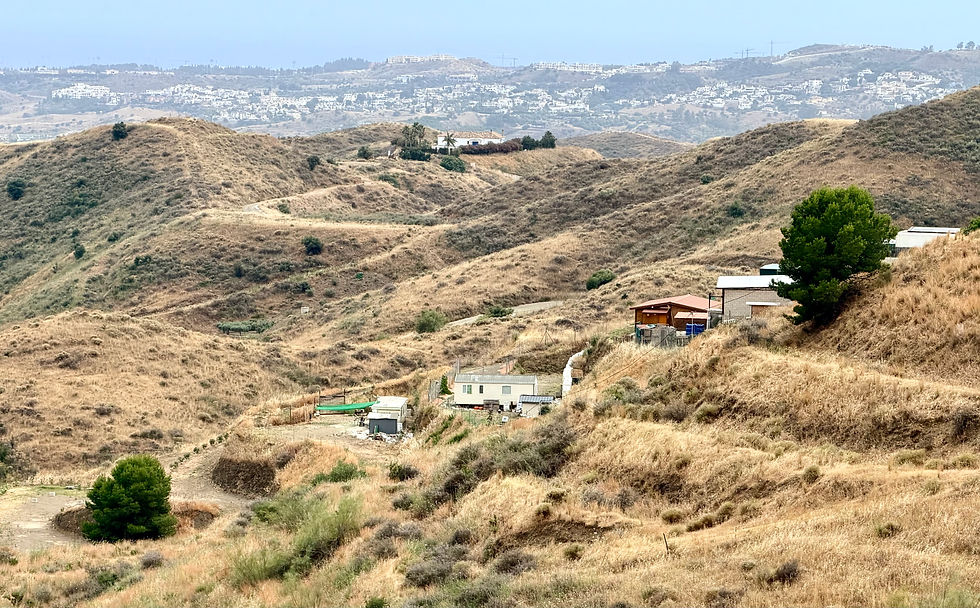
And lately, while mountain biking around Mijas, Coín, Alhaurín and the hills, I’ve been noticing something I haven’t seen on this scale in my 25 years on the Costa del Sol.
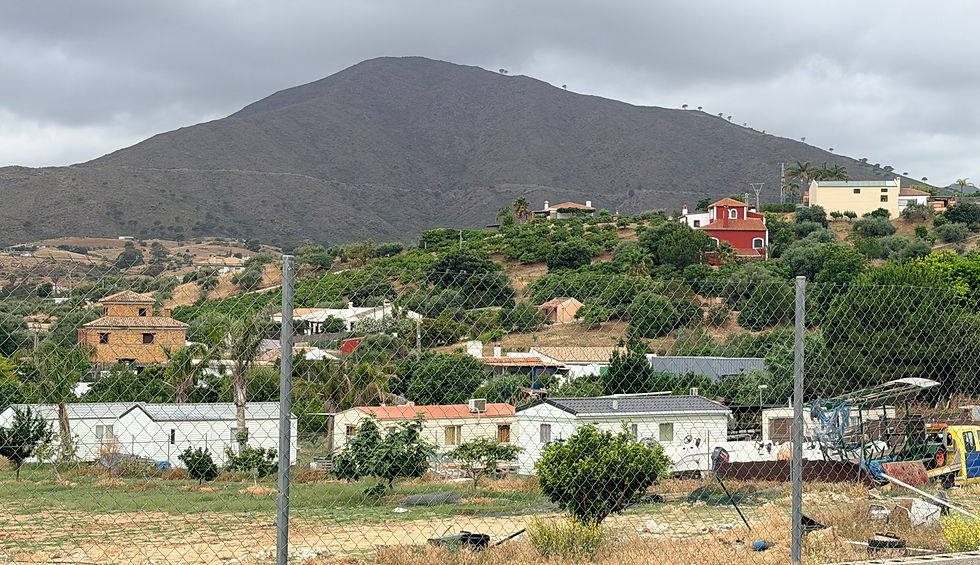
Large rustic plots suddenly being enclosed with tall aluminium fencing.
...Security cameras.
...Electric gates.
...Freshly cut access roads.
...Leveled slopes.
...Terraces carved into hillsides! And behind the fences? Mobile homes, modular homes, containers. One next to another. Sometimes a swimming pool or pergolas. Sometimes what genuinely looks like a mini gated community.
And I keep thinking…Hang on.
Since when did rustic countryside start turning into private urbanisations?
Because that’s exactly what some of these places are starting to look like.
Just with one small detail.
Without infrastructure.
Without sewage systems.
Without public roads.
Without planning.
Without all the costs and obligations a legal developer must comply with.
Apparently if you add wheels, everything becomes fine?
Well… not exactly.
The Biggest Myth I Keep Hearing
“It’s a mobile home, so you don’t need planning permission.”
I hear this so often that I’m starting to think it comes free with every rustic land listing.
So let’s say this clearly.
Spanish authorities do not really care whether your house has wheels.
They care whether you are living in it.
That’s the part many people misunderstand.
Does it have water?
Electricity?
Septic tank?
Terrace?
Swimming pool?
Barbecue?
...Wi-Fi password stuck to the fridge? Great....Good luck explaining to the town hall or planning department that it’s just a “temporarily parked trailer.”
Because in reality, if a mobile home is being used for permanent or long-term residential living on rustic land without the required permissions, that may be illegal.
And I want to be very clear here for anyone considering this route.
This is not some harmless grey area where worst case you get a slap on the wrist.
In more serious cases, consequences may include:
heavy fines
demolition orders
restoration of the land
legal proceedings
and yes, in some serious planning offence cases in Spain, even prison sentences
That tends to shock people.
Because many assume:
“But everyone is doing it.”
I’ll say something that may sound harsh.
Just because lots of people are doing something does not make it legal.
It only means lots of people are taking the same risk.
Those are not the same thing.
One Mobile Home Is Not the Real Issue
Let me be fair.
I don’t believe the main issue is someone placing one mobile home on a large rural plot and quietly living there.
That’s not what worries authorities most.
What worries them is what I’m increasingly seeing.
A large rustic plot gets purchased.
It gets divided informally.
Private roads appear.
CCTV gets installed.
Several residential units are placed side by side.
A pool appears.
Solar systems appear.
Water tanks appear.
Suddenly you no longer have one off-grid dream.
You have what is effectively a residential development.
Just without being called one.
No developer.
No infrastructure.
No proper planning.
No sewage network.
No legal urbanisation.
No millions spent on permits, engineers, roads, drainage and compliance like a normal developer would have to spend.
Sounds like a fantastic business model, right?
Short term ...maybe.
Long term? That’s where reality usually arrives.

Let’s Be Honest — This Is Often About Money
I know people love branding this as freedom, sustainability and returning to nature.
And for some people, that genuinely is the motivation.
But let’s not pretend that’s always the case.
A lot of what I’m seeing is driven by money.
Someone buys cheap rustic land.
Splits it.
Places multiple units.
Sells them or rents them.
And suddenly creates a profitable business model.
Essentially a housing development disguised as off-grid living.
That is exactly why authorities are starting to pay attention.
Because while one developer spends millions complying with regulations…
Someone else is trying to build a mini residential park behind a fence for a fraction of the cost.
You don’t need to be a genius to understand why that eventually creates conflict.
Why Foreign Buyers Need to Be Extra Careful
This is the part I really want foreigners to understand.
Especially those moving here with limited budgets, looking for a more affordable way to live in Spain.
I know many people are not trying to “cheat the system.”
They simply want a peaceful, sustainable life in nature...And that’s fair.
But please don’t confuse a lifestyle dream with legal reality.
I’ve seen some real estate agents openly marketing rustic land as if mobile homes and container living are the next guaranteed investment boom.
That worries me.
Because it creates the impression that this is some magical loophole authorities are happy to ignore.
History on the Costa del Sol says otherwise.
If you’ve lived here long enough, you’ve seen this movie before.
I remember Marbella during the era of Jesús Gil.
At the time many people believed the boom would continue forever.
Rules didn’t matter.
Controls would never come.
Everyone was making money.
Everything was “fine.”
Until it wasn’t.
Then came investigations.
Court cases.
Demolitions.
Fines.
We saw something similar recently with short-term rentals through Airbnb.
A few years ago people said:
“Airbnb will run forever.”“Nobody can stop it.”“Easy passive income.”
Really?
Now look.
Registrations.
Licensing.
Restrictions.
Community bans.
Inspections.
New obligations.
The Costa del Sol has a funny habit.
History repeats itself.
First comes the boom.
Then easy money.
Then everybody copies everybody.
Then it gets out of control.
Then come complaints.
Then regulation.
Always.
So What Happens Next?
My personal opinion?
We are still in the boom phase.
Right now many people think they’ve found a loophole.
But I strongly suspect the next few years will bring:
more inspections
more fines
more demolition orders
tighter septic and wastewater controls
stronger flood-zone enforcement
stricter rules around mobile homes
more scrutiny of rustic land subdivisions
Especially in areas vulnerable to:
flooding
wildfires
environmental damage
illegal wastewater disposal
Because eventually authorities ask the same questions.
Where does the water come from?
Where does the wastewater go?
Who maintains the roads?
What happens during a wildfire?
What happens during flooding?
Who is liable when something goes wrong?
At some point, somebody has to answer those questions.
My Advice
If you are considering buying rustic land for off-grid living, a mobile home, a modular home or container housing, please, before sending a reservation deposit and choosing the colour of your pergola, do one thing.
Get proper independent advice.
Verify:
what is actually legal on the land
what local planning regulations allow
water access
wastewater disposal
electricity options
access rights
future resaleability
Don’t ask:
“What are other people doing?”
Ask:
“What is actually legal and permitted?”
Those are two very different questions.
And if something sounds unusually easy, unusually cheap and unusually profitable…
There is usually a reason.
And on the Costa del Sol, we’ve seen this story before.


Comments