
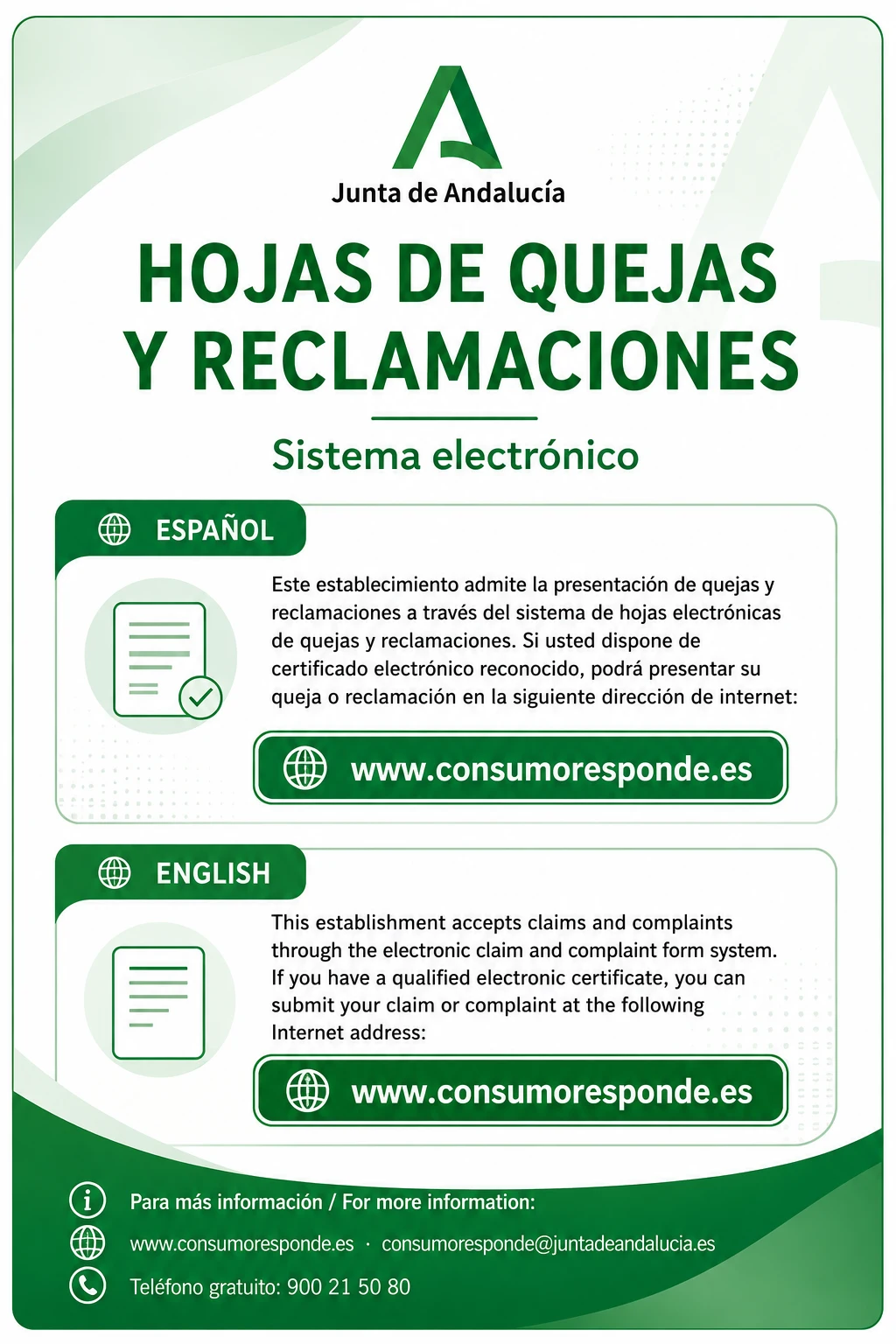
In recent days, posts about new rules for tourist rentals in Andalusia have been appearing everywhere. One post claims that Airbnb is coming to an end in Spain, another warns about fines, while others mention new QR codes and mandatory complaint forms.
So I sat down and went through the official BOJA publication as well as information directly from the Junta de Andalucía, because, as usual, there seems to be more panic than facts surrounding the issue.
So, what has actually changed?
At the end of April 2026, the Junta de Andalucía issued a new regulation concerning the consumer complaints system called Hoj@.
Official BOJA publication: BOJA – Order of 24 April 2026
Until now, most businesses in Andalusia operated more or less like this:
“Yes, yes, we have hojas de reclamaciones… somewhere in a folder… probably.”
And that was often the end of it.
Under the new rules, however, simply having paper complaint forms will no longer be enough.
Clients must also be given the option to submit a complaint electronically.
Does this apply to VUT properties and Airbnb as well?
The short answer?
Yes. And most likely to nearly all of them.
If you rent out:
- a VUT property
- through Airbnb
- an apartment through Booking.com
- or provide accommodation services in Andalusia
then you fall under the category of service providers dealing with consumers.
That means the Hoj@ system applies to you as well.
How will it work in practice?
The owner registers with the Hoj@ system and provides guests with access to the electronic complaint procedure.
The most likely options will be:
- a QR code in the apartment
- a link in the house manual
- a link in the check-in instructions
- information in the guest book
For example, next to the Wi-Fi password there could be a small notice saying:
Hojas de reclamaciones / Complaint forms
Scan here → QR code
The guest scans the QR code with their phone and submits the complaint electronically.
And here is one important point that many people misunderstand:
Airbnb does not handle these official complaints on your behalf.
Airbnb deals with:
- damage claims
- cancellations
- disputes handled through the platform
But the Andalusian hojas de reclamaciones are a completely separate system.
It is an official consumer protection mechanism operated by the Junta de Andalucía.
So even if you run your rental entirely online, this obligation does not disappear.
What is the most important part?
Traceability.
In the past, many things could simply “get lost.”
Now the system will be able to see:
- when the complaint was submitted
- whether you responded
- when you responded
- what documents you attached
And under the new rules, you have:
10 working days
to respond.
That is significant.
So simply ignoring the complaint and hoping the guest gives up will no longer be enough.
When does it take effect?
For most smaller businesses and VUT owners, the deadline is:
20 May 2027
Larger companies have an earlier deadline.
That may sound far away, but we know how things often work in Spain…
For the first year, almost nobody deals with it, and then everyone starts panicking in the final month.
How to register — step by step
Step 1: Check whether the obligation applies to you
If you operate a tourist rental in Andalusia, it very likely does.
Step 2: Prepare your digital identification
You will need either:
- a digital certificate
or
- Cl@ve
If you do not have either of these yet, start there.
Step 3: Register with Hoj@
Official registration:
Hoj@ Empresas – registration
Information about the system:
Consumoresponde – Hoj@ Andalucía
Step 4: Prepare guest access
Ideally through:
- a QR code
- a notice displayed in the apartment
- a link in the check-in email
Step 5: Set up monitoring
Someone needs to regularly check:
- incoming complaints
- response deadlines
If you are a remote owner and everything is handled by a management company, make sure you know who will be responsible for this.
And what about the famous “cancellation of the national registration number”?
Another major source of confusion.
Yes, the Supreme Court annulled the central national registry for tourist rentals.
And the internet immediately started celebrating with comments like:
“Great, everything has been cancelled!”
No.
Unfortunately, it is not that simple.
The following have not been abolished:
- VUT licences in Andalusia
- inspections
- SES Hospedajes
- insurance requirements
- community restrictions
- urban planning controls
What was abolished was the ability of Madrid to impose its own centralised registry on the autonomous regions.
Andalusia, however, continues to maintain its own controls.
My view?
I increasingly see one very clear trend.
Andalusia is gradually putting an end to the “Wild West” era of tourist rentals, when anyone could buy an apartment, put it on Airbnb and operate with almost no rules.
Today, everything is becoming increasingly interconnected:
- registration
- guest reporting
- insurance
- complaints
- owners’ communities
- urban planning
- digital enforcement and monitoring
In other words…
If you own a VUT property, you need to start treating it like a proper business.
Not as a side project that “just runs by itself.”